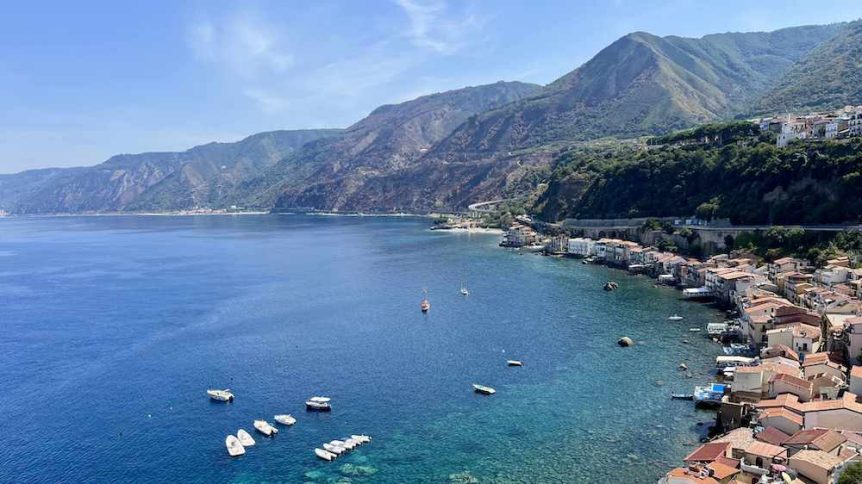
Scilla is blessed with the most picturesque of natural settings, between the forested Aspromonte Mountains and the Strait of Messina in Calabria, Southern Italy. The enviable location, characterized by a dramatic promontory reaching into the waters of the strait, stimulates imagination. Ancient peoples invented fanciful stories to explain the dangers of the passageway’s natural phenomena with legends dating back to prehistory. Peril still lingers in the name of this gorgeous destination for sand and swordfish along the alluring southwestern coast of the Italian peninsula.
“Scilla is one of the most striking bits of coast scenery, its white buildings and massive castled crag standing out in noble relief against the dark blue waves.” So wrote Edward Lear of limerick fame, one of many who have greatly admired the Southern Italian seaside community. While we may be more accustomed to the vibrant colors of contemporary photographs, Lear’s black and white image from his Journals of a Landscape Painter in Southern Calabria (1852) beautifully captures the spot’s appeal.
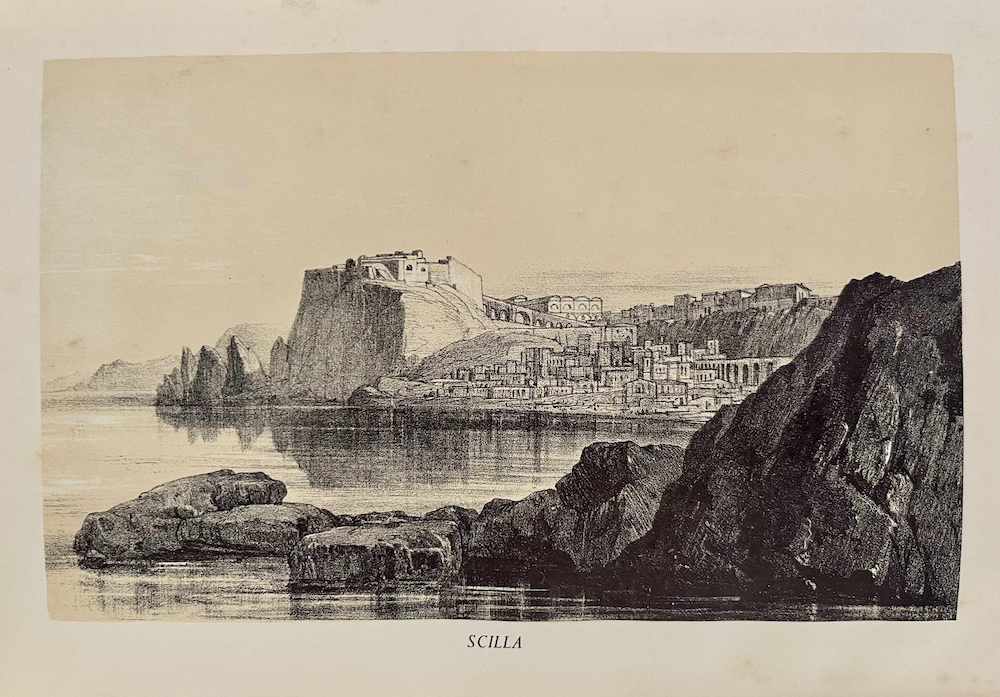
Edward Lear’s Scilla
WHO IS SCYLLA?
Visitors are drawn to the rock. Sailors historically avoided it as their boats weren’t a match for the strait’s dangerous currents. The Greeks were the first to pen a colorful myth to account for the difficulties posed. In Homer’s Odyssey, Odysseus must navigate between two sea monsters, Scylla and Charybdis. Scylla attacked the sailors on the Calabrian side and Charybdis was a whirlpool off the coast of Sicily, thus giving birth to the expression “to be between Scylla and Charybdis.” Thousands of years later, this satirical 18th-century print illustrates the concept with Prime Minister William Pitt as Odysseus at the helm, navigating Britannia through the strait, between the monarchy and democracy.
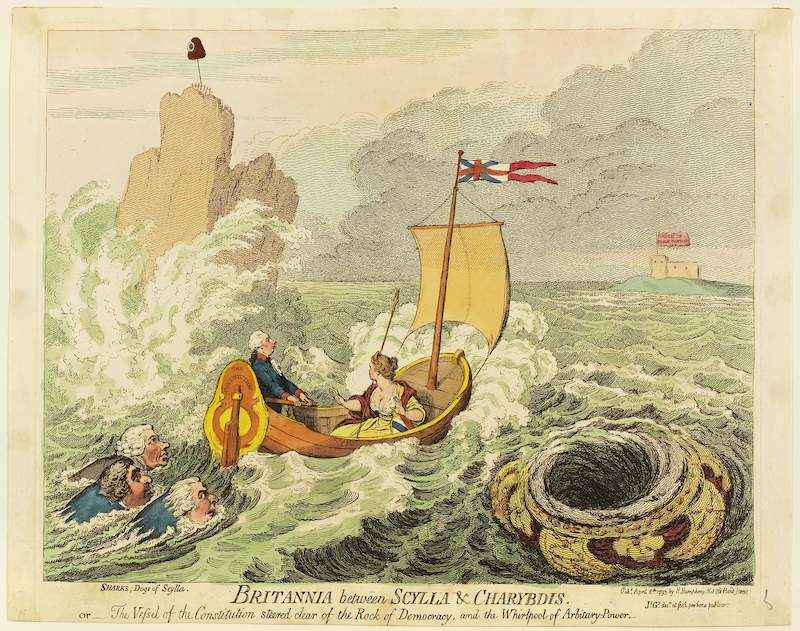
“Britannia between Scylla and Charybdis” (1793) by James Gillray
The Roman writer Virgil elaborated on the legend in his Aeneid, pinpointing the location as the Strait of Messina, which separates Calabria on the Italian mainland from the island of Sicily. Subsequent generations embellished the account with creative backstories and scenarios. To give Scylla proper motivation, several narratives have her start out in life as a beautiful sea nymph who was turned into a monster by a jealous goddess. Here is a 3rd-century-BC sculpture of Scylla from Southern Italy, on display at the British Museum.
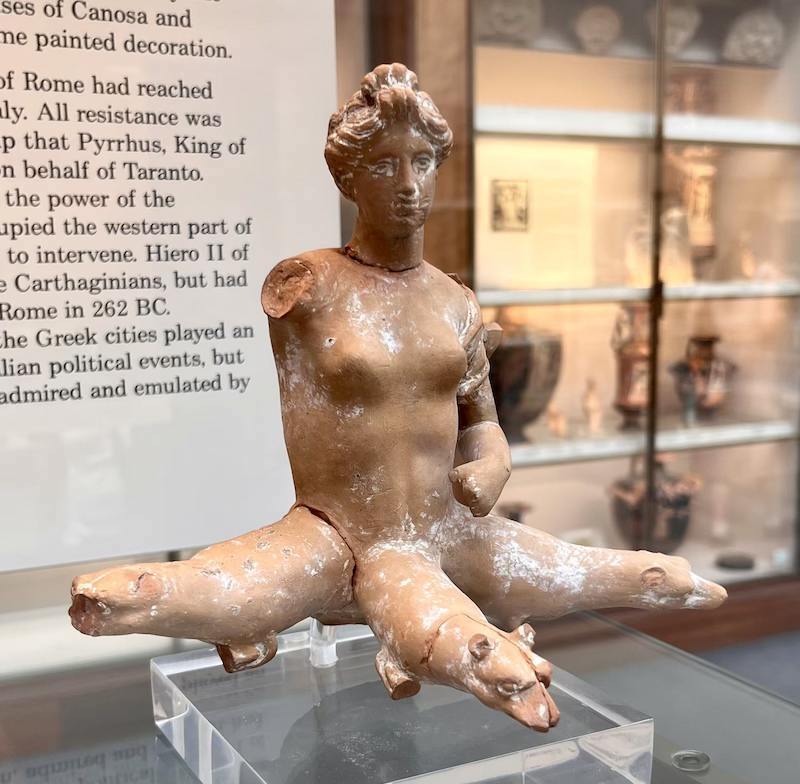
Terracotta figure of the monster Skylla, made in Southern Italy, 250-200 BC
The community that came to be called Scilla carries forth the theme with this contemporary sculpture of the monster in a public square. Six vicious dogheads come out of Scylla’s thighs, poised to grab seafarers from their boats and eat them alive. And to give nightmares to schoolchildren…
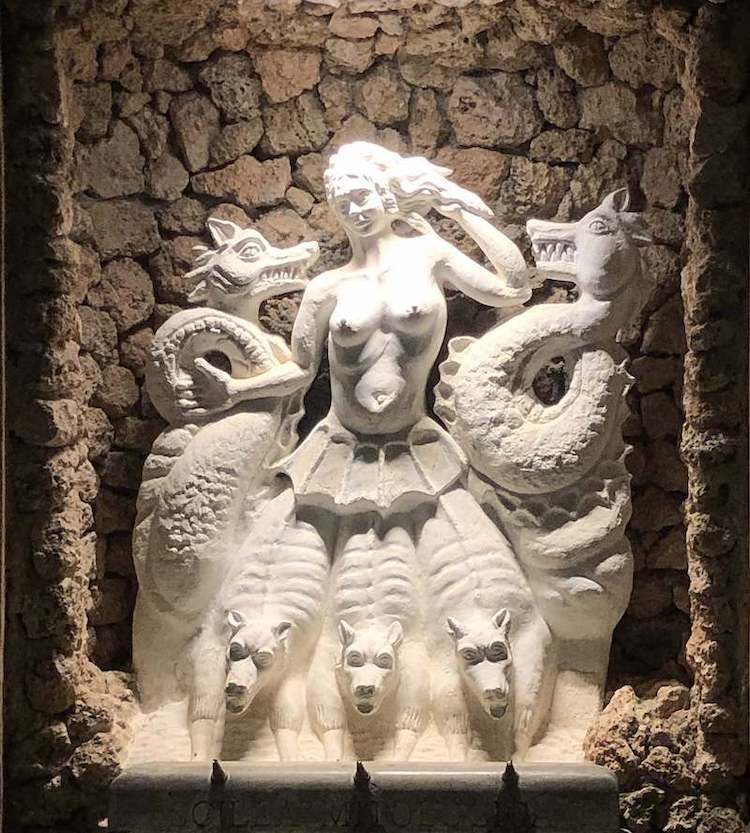
Scylla, the monster (courtesy of Wikimedia, Creative Commons 4.0)
SCILLA, THE TOWN
Looking at Scilla today from pretty much any angle, it’s hard to believe that the name derives from such a ferocious, unattractive being, but I suppose it lends character and perhaps subconsciously kept people away.

Scilla’s outcropping topped by the castle
Scilla has certainly suffered over the years. The town is mentioned in the writings of numerous English-speaking travelers who passed through, making a point to stop in this famous spot of Scylla and Charybdis fame. Several travelogues refer to the devastation of the 1783 Calabrian earthquakes and the subsequent tsunami.
Thrown back towards the Calabrian coast, it passed with impetuosity over the shore of Scilla; and, in its retreat to the bosom of the deep, swept from its surface every individual who had thought to find safety in the bareness of its sands. One abhorrent shriek uttered by the united voices of 4000 beings, thus snatched to eternity, re-echoed from the mountains; and the tremendous wave returning a second and last time, rose to the elevation of the highest houses that yet remained entire, and buried many of them in masses of mud and sand, leaving on their flat roofs, and among the branches of the trees which grew out of the impending rocks, the mangled bodies of the victims it had destroyed. But these were not many; for the mass, including the Prince of Scilla, were never seen or heard of more.
A Tour Through the Southern Provinces of the Kingdom of Naples (1821)
by Richard Keppel Craven
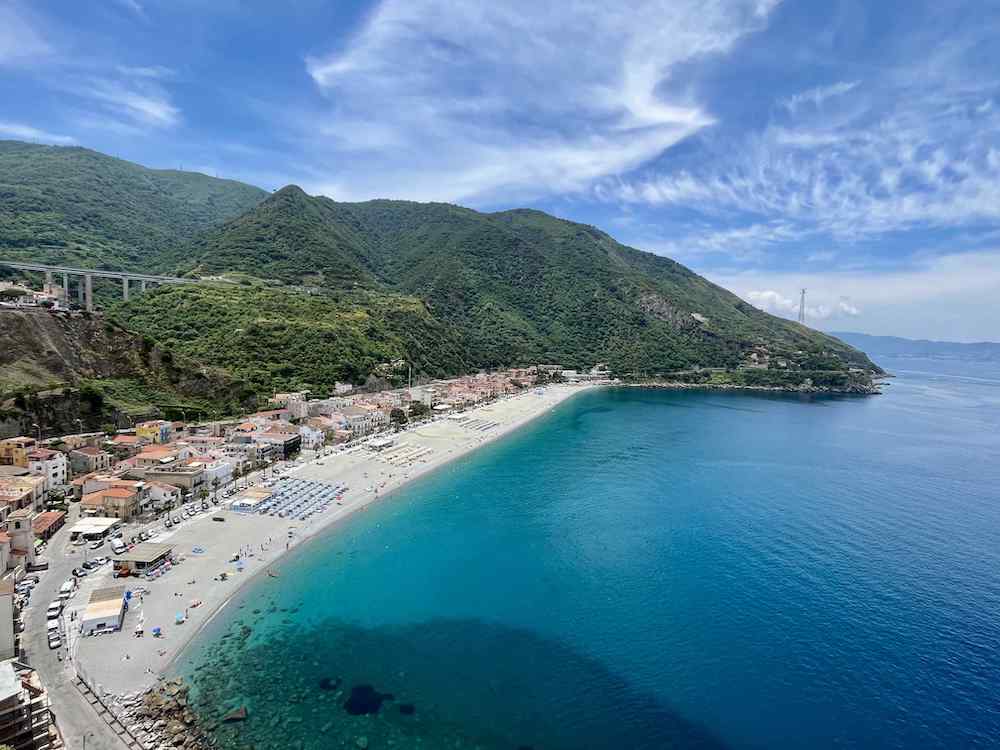
Scilla beach at the start of the season
SCILLA CASTLE
Almost two hundred years after that quake, which was followed by another large one in 1908, a fellow Englishman described the state of the fortress:
The ancient castle on the rock is now a ruin, but part of it has been transformed into probably the most elegant and attractive youth hostel anywhere in the world, certainly no other can compete with it for romantic interest. The entrance is an old gate studded with hundreds of nails, and a bell hangs near; a lantern above the archway illuminates the arms of the Princes of Ruffo, the owners of the castle. Seated at a refectory table beneath a vaulted ceiling, guests can now watch television upon the Rock of Scylla!
A Traveller in Southern Italy (1969)
By H. V. Morton
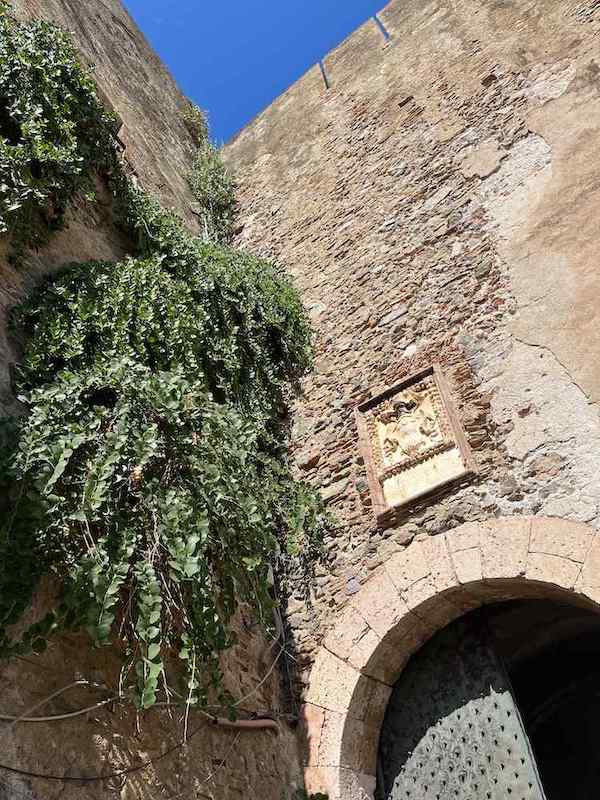
The Ruffo di Calabria coat of arms over the castle entrance with caper plants growing out of the walls
The castle remains on the promontory, from under which Scylla, the monster, hasn’t been seen nor heard recently. Through earthquakes and erosion, the rock formation has undoubtedly changed. There is, of course, radar to assist contemporary sailors, and the lighthouse, which dates from 1913, is looked after by the Italian navy.
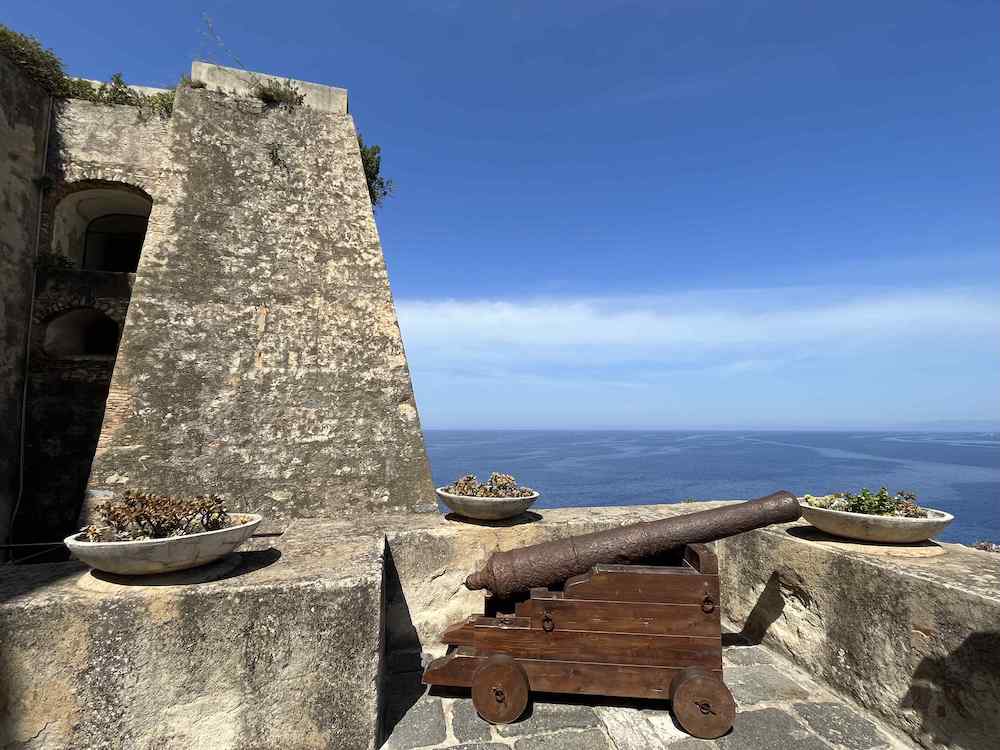
Looking onto the Strait of Messina from the castle
Scilla Castle is presently in the hands of the state, although it is commonly referred to as Castello Ruffo after the noble family who owned it back from 1533. Visitors can no longer sleep inside the stone walls, but several interior spaces have been renovated to house an exposition about local swordfishing and to hold special events.
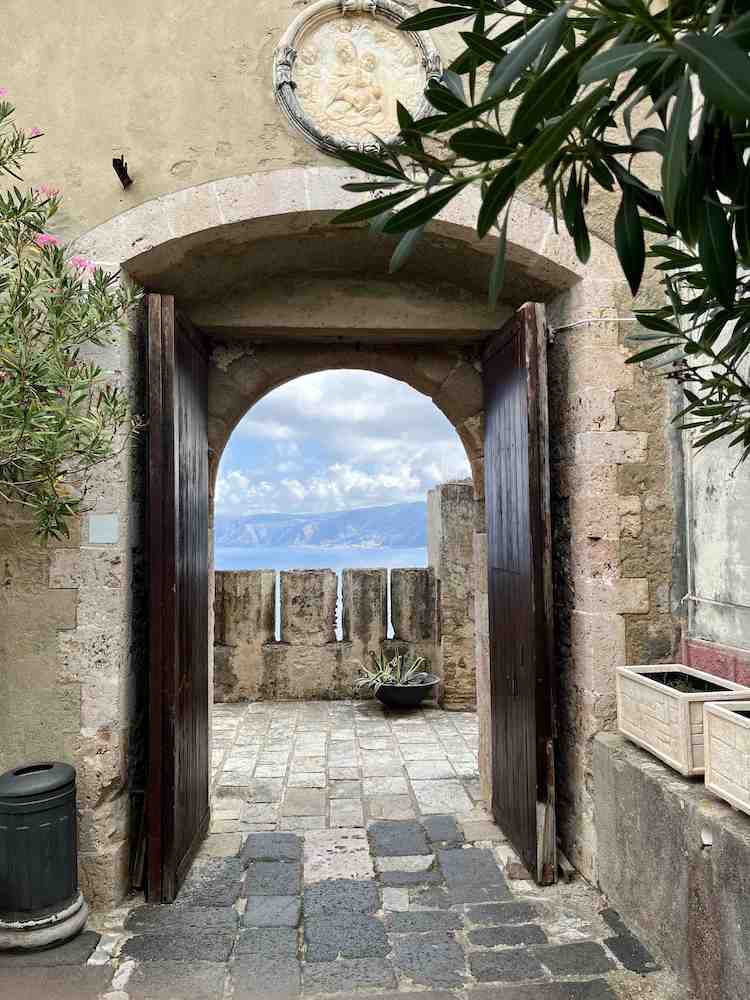
In the castle courtyard
The views from the “Rock of Scylla,” however, are stunning. To the south, there’s Marina Grande, the lovely beach area, full of chairs and umbrellas in the summer months.
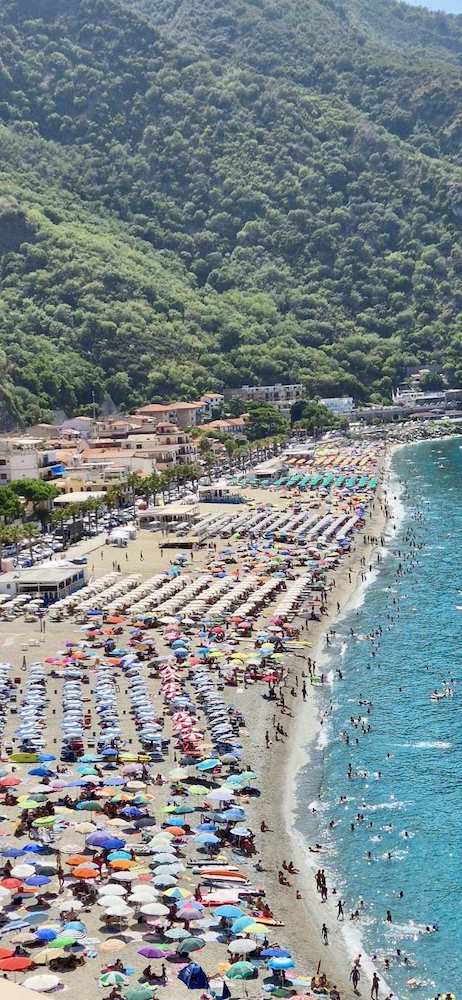
Scilla beach in August
Sicily and, on a clear day, the Aeolian Islands are out to sea, and the port is at the rock base with the charming “Chianalea” neighborhood to the north.
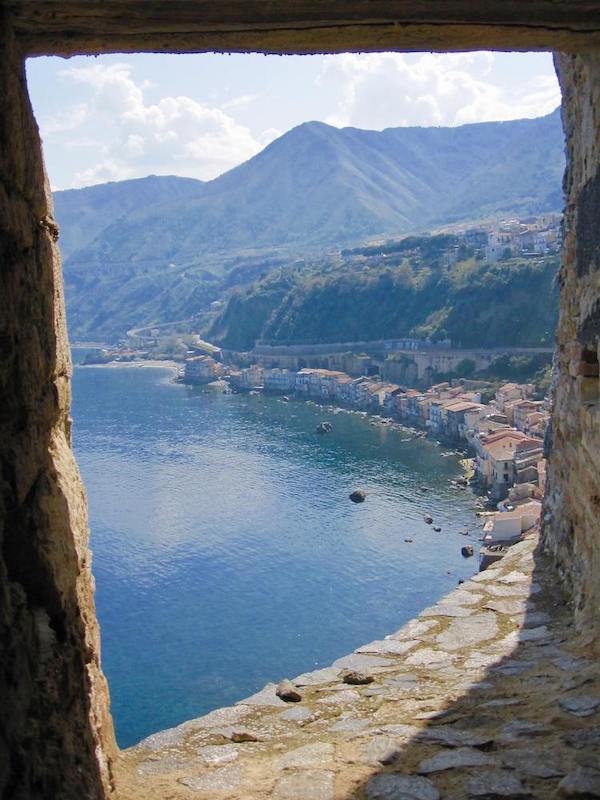
View of Chianalea from the castle
CHIANALEA, SCILLA
Of all Scilla’s picturesque spots, Chianalea stands out for the uniqueness of its houses built right up to the water. Tourist materials often refer to the enchanting fishing village as the “piccola Venezia,” little Venice of Italy. Small indeed, as Chianalea is on the list of the Borghi più belli d’Italia or Italy’s Most Beautiful Villages, which by definition have a maximum of 1,000 residents. Scilla in its entirety, from the coastal to inland areas has a population over four times that number, when all of the quartieri, quarters or neighborhoods, are taken into account.
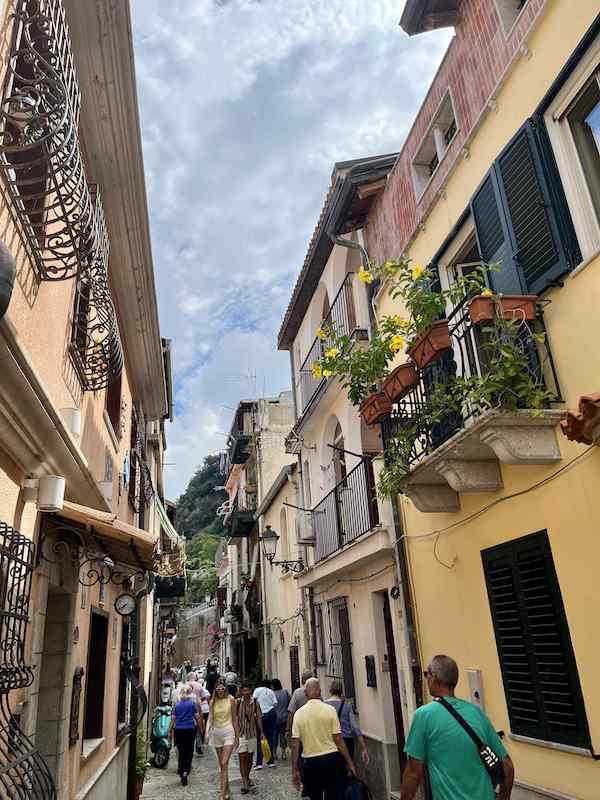
Out for a stroll in Chianalea, one of the Borghi più belli d’Italia (Italy’s Most Beautiful Villages)
The narrow, multi-storied fishermen’s dwellings fascinate visitors, whether viewed from the castle, sea, or on a stroll through the village’s cobblestone lane from where you can catch glimpses of the sea between the simple lodgings or even straight through the front door.
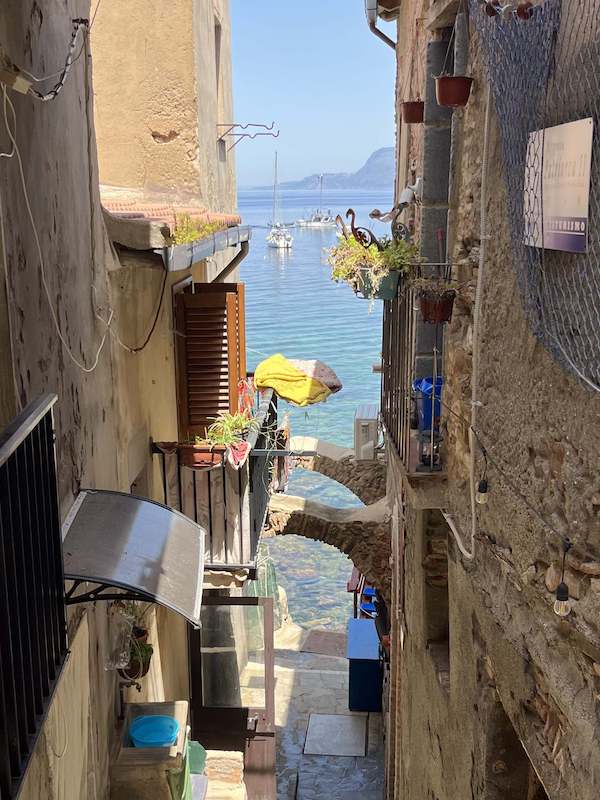
Chianalea fishing village on the Strait of Messina
This larger cove with fishing boats is particularly characteristic and amongst the most photographed.
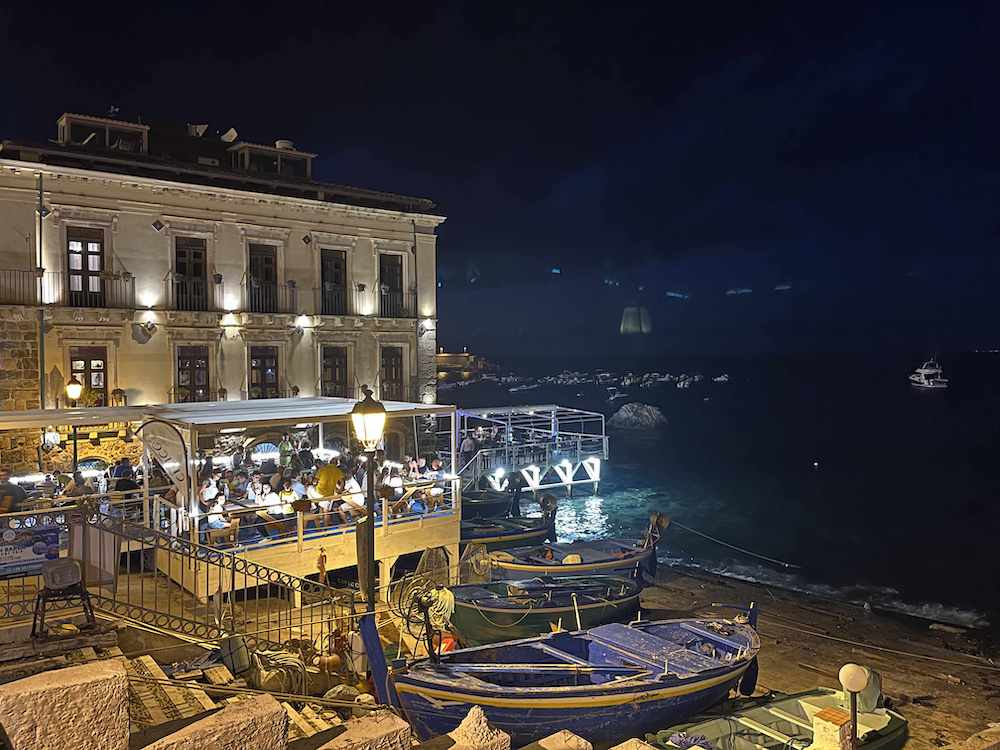
Chianalea at night
Restaurants, shops and B&Bs beckon. Chianalea has seen quite a transformation over the past two decades. The original owners were fishermen. Today, their simple habitations have opened their doors to tourism.
SWORDFISH – PESCESPADA
Pescespada or swordfish has always been important for the economy of the strait and continues to be so for Scilla. On display at the castle, this traditional, oared, wooden boat with a raised pedestal for the spotter, called a lontre by the locals, was used through the 1950s.
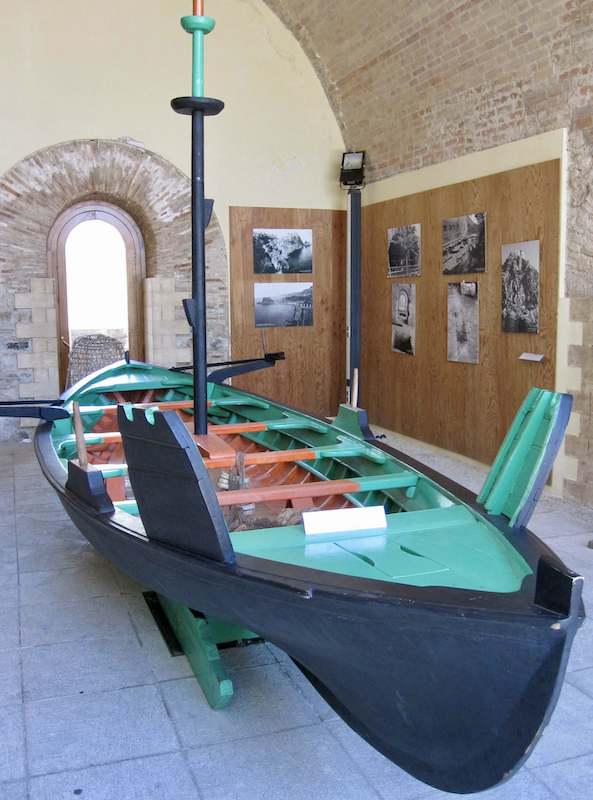
Traditional wooden boat used for hunting swordfish in the Strait of Messina
Today, they hunt swordfish with special motor vessels, called passerelle (word for gangways or elevated walkways), with a very tall surveillance post and a long runway for the harpooner.
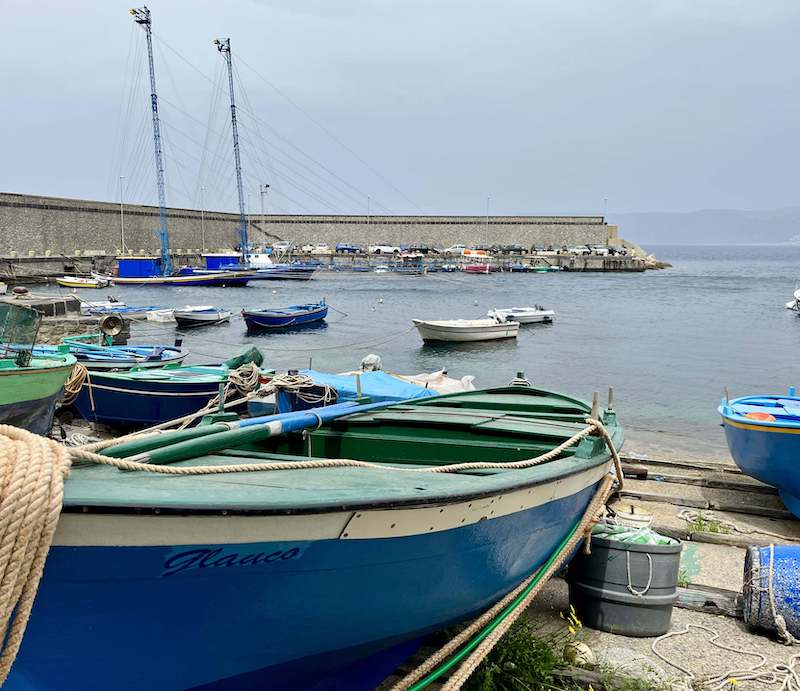
In the port, a mix of classic fishing boats and high-posted modern boats for spotting swordfish
Of course, swordfish is a specialty in local restaurants, even back when Arthur John Strutt visited the area in 1841. The British writer relished his meal in Scilla and described the contents in his A Pedestrian Tour in Calabria and Sicily: “macaroni, fried slices of swordfish served with oil and vinegar, salad, fresh curds, oranges, and almonds; the whole seasoned with a flask of that dark Calabrian wine, the strength and flavour of which gradually improve as we proceed southward.”
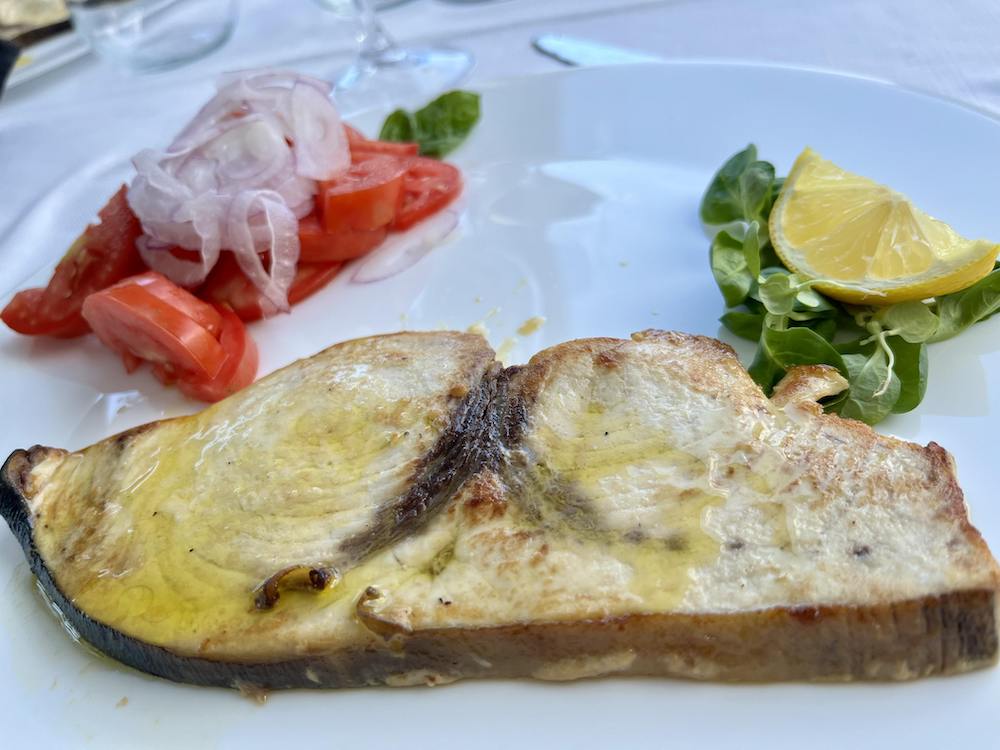
Grilled swordfish
Contemporary diners tend to pair swordfish with one of the region’s excellent white wines, although the meaty texture can work with reds, as well. Grilled swordfish is quite popular, but the fish is prepared in many ways, such as involtini di pescespada (swordfish rolls), polpette di pescespada (swordfish balls),
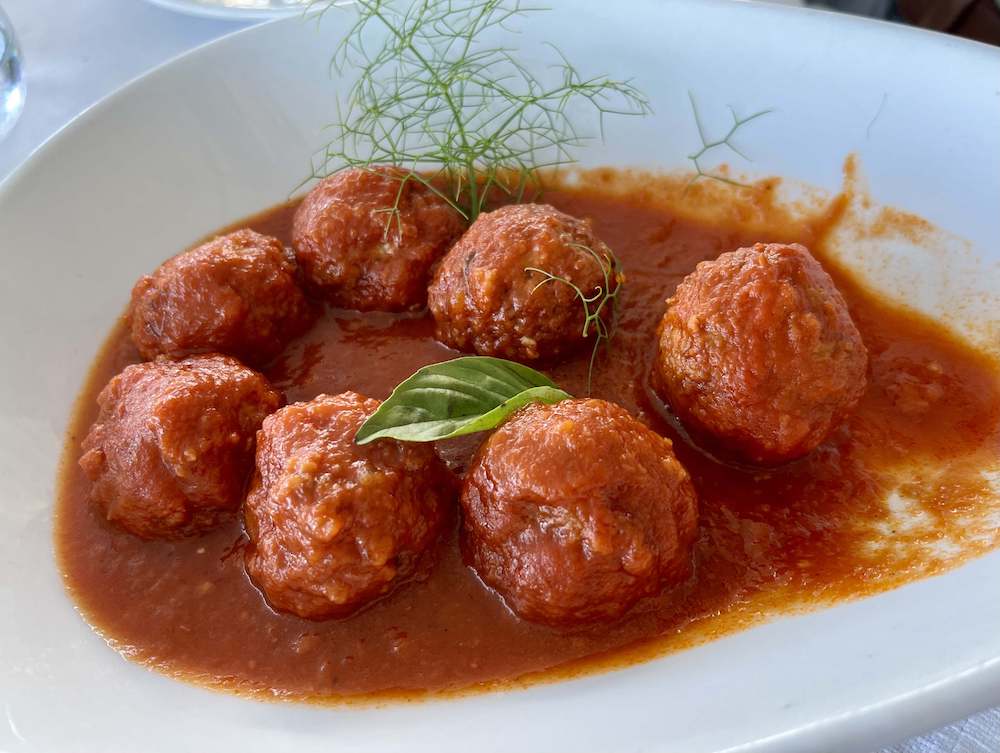
Polpette di pescespada or swordfish balls
tortino di pescespada (a savory pie), lasagne di pescespada, and not to leave out pasta in all its forms, of which paccheri are often on the menu.
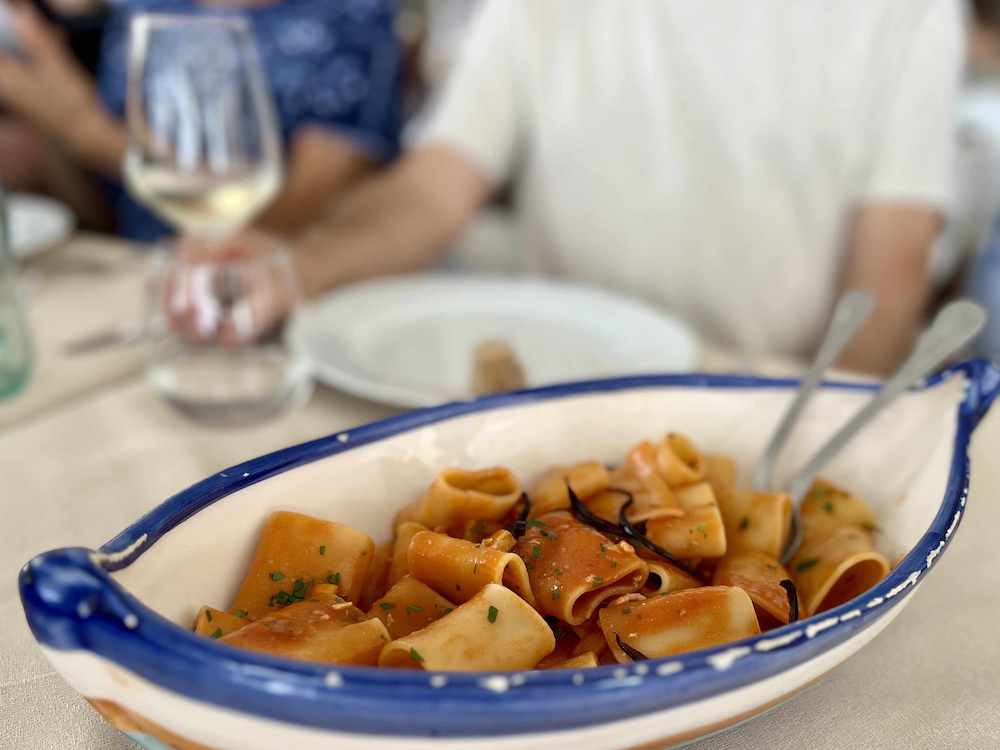
“Paccheri” pasta with swordfish, served in a ceramic boat
VISIT SCILLA
Scilla is becoming ever more popular, not only for intellectuals armed with Homer and Virgil, but for influencers wielding selfie sticks. One seeks out a connection, a thread with the past, while the other, a visual backdrop, which has been recently polished with renovations and updates.
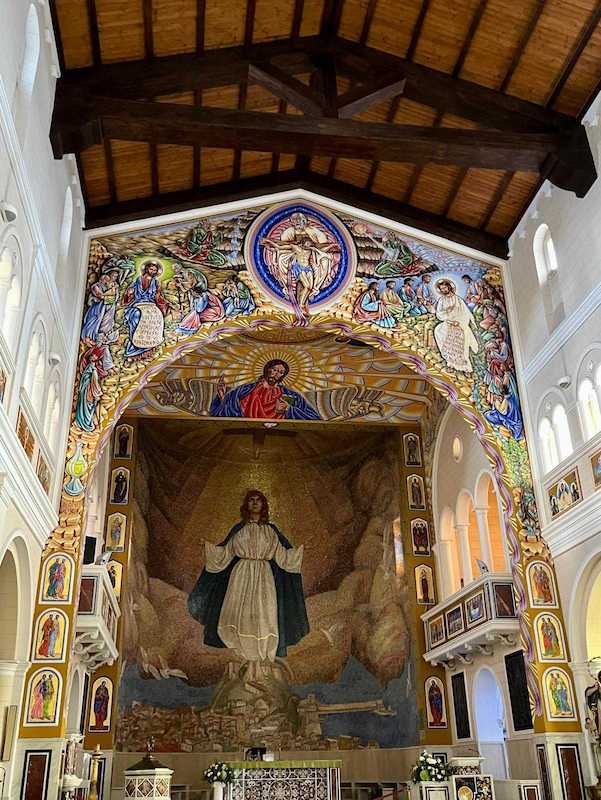
Scilla’s Mother Church dedicated to the Madonna dell’Immacolata – note the mosaic behind the altar with a depiction of the village at the angel’s feet
What would Ulysses think if he were to sail through the strait today, encountering small fishing boats, snorkelers or scuba divers, undaunted by “the rock”? Highlights of his reaction would no doubt be documented on all forms of social media. Of course, this is not to say that there aren’t fierce winter storms, with waves battering the structures not only on the water in Chianalea but past the beach of Marina Grande, as well.
Previously, Scilla was a favorite spot for locals, whether from the Province of Reggio Calabria, calabresi from further afield or those who had emigrated abroad. There is still elbow room as compared with Italy’s better-known destinations, but I wouldn’t recommend the height of summer or a holiday weekend if you have hopes of finding a place to park.
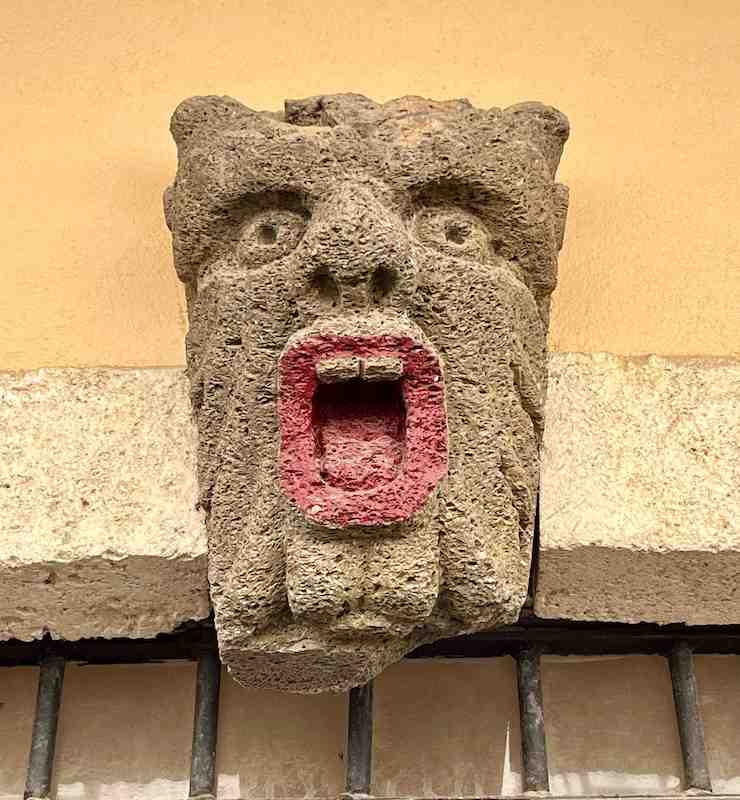
A stone grotesque above a doorway in Chianalea
Scilla is on the main north-south train line, about 15 miles north of Reggio Calabria, the region’s largest city. You can reach Sicily by a short ferry ride from nearby Villa San Giovanni or by hydrofoil from Villa SG or Reggio. Or you can come on one of my highly rated Calabria tours!
Join me on one of my small-group Calabria Tours (three different itineraries from which to choose) or on my Basilicata Tour of Calabria’s northern neighbor.
Read about the fascinating Calabrian region in my book Calabria: The Other Italy, described by Publisher’s Weekly as “an intoxicating blend of humor, joy, and reverence for this area in Italy’s deep south,” and explore Calabria’s northern neighbor in my book Basilicata: Authentic Italy, “recommended to readers who appreciate all things Italian” by the Library Journal.
Follow me on social media: Basilicata Facebook page, Calabria: The Other Italy’s Facebook page, Karen’s Instagram and Karen’s Twitter for beautiful pictures and information.
Sign up below to receive the next blog post directly to your email for free.
Comments 4
I remember well from your tour how truly breathtaking the scenery is and how delicious the food and atmosphere are! We have stunning pictures and meaningful memories from our trip that we treasure!
Author
So pleased to know that Scilla and Calabria had such a lasting impact on you, and that my tour gave you the opportunity to experience the region’s great wealth.
As beautiful as your pictures in the blog are, Karen, they don’t do justice to how gorgeous the landscape is in person. We still reminisce about some of the special gourmet meals we had together. We need to get back there with you again!
Author
I agree, photos can entice and are beautiful to look at, but they can’t replace seeing these locations in person. I would be very happy to have you and your wife as guests on another itinerary and to have the opportunity to share more of Calabria with you.